
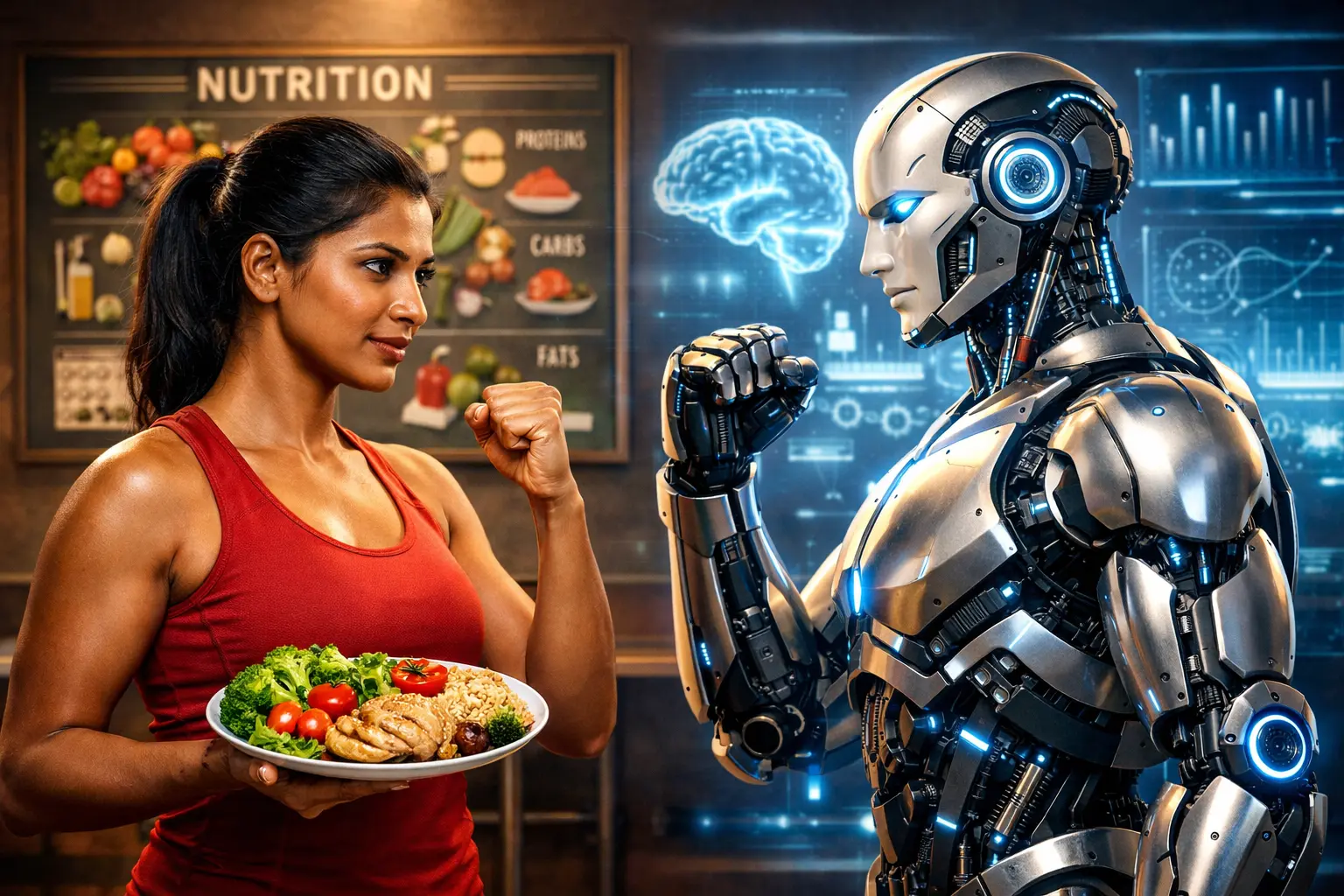
Nutrition Intelligence vs AI: The Real Edge
March 26, 2026
Rohan had been training clients for six years out of a mid-sized gym in Pune. He was good - consistent with programming, reliable with clients, respected by his peers. Then, last year, three of his regulars quietly moved their coaching to an AI fitness app. One of them told him directly: "Bhai, the app gives me a full meal plan and adjusts it every week. It's cheaper and I can check it any time."
Rohan didn't panic. He upgraded.
He enrolled in a certified nutrition course, spent three months learning the science and art of clinical nutrition, and went back to his clients - not to compete with the app, but to do what the app structurally could not. Within four months, two of those three clients returned. The third had already plateaued on his AI-generated plan and was starting to wonder why.
What Rohan had developed was nutrition intelligence. And no algorithm, however sophisticated, has figured out how to replicate it.
Let's Be Honest: AI Is Not the Enemy
Before we make the case for human expertise, let's give credit where it's genuinely due - because dismissing AI would be both dishonest and strategically dumb.
AI in the fitness industry in India has delivered real, measurable value. Apps like cult.fit and a growing cohort of algorithm-driven coaching platforms have done something important: they've made basic fitness guidance accessible to millions of people who previously had none. For a first-generation gym-goer in Jaipur or a young professional in Hyderabad who can't afford a personal trainer, a well-designed AI app is genuinely better than nothing.
Here is what AI does exceptionally well:
- Macro and calorie calculation based on body weight, goal, and activity level
- Generic weekly meal plan generation with food substitutions
- Workout programming for common goals - fat loss, muscle gain, maintenance
- Progress tracking and automated plan adjustments
- 24/7 availability and consistent, non-judgmental delivery
If your value as a fitness professional stops at "I make meal plans and track macros," then yes - AI is a direct threat. But that's a very limited definition of what a great nutrition professional actually does.
The Gap No Algorithm Can Bridge
What AI Sees vs What Actually Governs Food Choices in India
Here's what an AI fitness app sees when your client checks in: age, weight, height, goal, caloric intake, and maybe a food log. Here is what it doesn't see:
- That your client from Lucknow grew up eating four rotis for dinner because that's what love looked like in their household
- That your client is a practicing Jain who won't eat root vegetables - and the "plant-based" template the app generated is full of them
- That your client's mother-in-law makes ghee-laden halwa every Sunday, and telling her not to eat it would unravel three relationships at once
- That your client is a 34-year-old woman with subclinical hypothyroidism who is following every macro to the letter and still not losing weight
- That your client binge-eats at night after emotional stress at work - and the issue isn't the food, it's the cortisol
India is not a monolith. Our food culture is layered with regional identity, religious practice, family obligation, seasonal availability, and deep emotional memory. A trainer in Coimbatore working with a Tamil Brahmin client who observes Ekadashi every fortnight is operating in a completely different food world than a trainer in Chandigarh working with a Punjabi athlete who treats dal makhani as a recovery food.
AI produces a plan. Nutrition intelligence produces a protocol that a real person in a real cultural context can actually follow.
This is not a small distinction. This is the entire game.
The Plateau Problem: Where AI Clients Always End Up
Here is a predictable cycle that is playing out across gyms in tier-2 cities right now: A client leaves their trainer for an AI app. They see initial results - the novelty effect, the calorie deficit working, the dopamine of a structured plan. Then, somewhere between weeks eight and sixteen, they plateau. The app adjusts their macros. They plateau again. The app suggests adding cardio. Nothing significant changes.
The client is stuck, and the app has run out of algorithmic levers.
What the app cannot do is ask:
- "Have you been sleeping? Are you under unusual stress? Has your menstrual cycle shifted? Are you secretly skipping meals and compensating at night? Has your family been going through something? Has the type of training changed in a way that's affecting your hunger patterns?"
These are not questions AI can meaningfully interpret. But a fitness professional with strong nutrition intelligence asks them instinctively - because they understand that the body is not a calorie-in-calorie-out machine. It is a hormonal, psychological, social, and cultural system. Managing that system is a human skill.
Defining Nutrition Intelligence: The Irreplaceable Human Edge
Nutrition intelligence is not just knowing the difference between a simple and complex carbohydrate. It is the trained ability to:
- Read a client's physiological signals beyond what they self-report
- Contextualise dietary advice within a client's cultural, emotional, and logistical reality
- Recognise patterns - hormonal, behavioural, metabolic - that standard tracking cannot surface
- Build the trust required for clients to be honest about what they're actually eating
- Deliver recommendations that clients will follow in the real world, not just in theory
This last point is undervalued enormously. The most nutritionally precise plan in the world is worthless if your client can't follow it at their parents' home during Diwali week, on a business trip to Bengaluru, or when they're going through a rough patch at work. Compliance is a human problem. And solving it requires human intelligence.
AI optimises for the ideal. Nutrition intelligence operates in reality.
Two Trainers. Same City. Different Futures.
Consider two trainers - both working in the same mid-size city in Maharashtra, both with roughly five years of experience.
Trainer A has a solid foundation in fitness programming. For nutrition, he relies primarily on AI-generated meal plans and macro calculators. He's efficient, his plans look good on paper, and his clients get results initially. His monthly fee is around ₹2,500–3,500. Client retention at the six-month mark hovers around 40%.
Trainer B completed a certified nutrition course two years ago. She doesn't just prescribe macros - she conducts a detailed intake assessment, asks about food history, cultural background, stress levels, and sleep. She adjusts plans not just for calories but for practicality: she knows her client can't cook twice a day, that her client's evening social life involves chai and snacks, that her client's cycle affects her carbohydrate needs in week three of the month. Her monthly fee is ₹5,000–8,000. Client retention at six months is close to 78%.
Same city. Same gym type. Trainer B is not smarter about algorithms. She is smarter about people - and she has the structured knowledge to back it up.
Comparison Table:
Trainer A (AI-Reliant) vs Trainer B (Certified in Nutrition)
Client Retention (6 months): ~40% vs ~78%
Monthly Fee (₹): 2,500–3,500 vs 5,000–8,000
Handles Plateaus?: Adjusts macros (algorithm) vs Diagnoses root cause; adjusts lifestyle
Cultural Personalisation: Generic templates vs Roti vs rice, fasting days, family meals
Client Trust Level: Moderate vs High - feels understood
Referral Rate: Low vs High - word-of-mouth driven
The difference between these two career trajectories is not luck, not location, not even natural talent. It is structured, certified nutrition knowledge layered on top of fitness expertise - the combination that creates a professional that clients genuinely cannot replace with an app.
The Career Opportunity Inside the AI Disruption
The fitness industry in India is undergoing rapid bifurcation. On one end: commoditised, algorithm-driven coaching that competes purely on price and convenience. On the other: deeply qualified professionals who command premium fees, build lasting client relationships, and generate referrals through genuine results.
The trainer who fears AI is fighting the wrong battle. The trainer who uses AI anxiety as a reason to upgrade their human expertise - that's the one building a sustainable career.
Pursuing a certified nutrition course in India does several things that no AI tool can replicate:
1. It Gives You Clinical Credibility
When a client is dealing with PCOS, thyroid dysfunction, digestive issues, or hormonal imbalances, they don't want an app. They want someone who understands what's happening in their body and can work within it. Certification signals to clients - and to themselves - that you have earned the right to that conversation.
2. It Gives You a Structured Protocol, Not Guesswork
A nutrition course for fitness trainers teaches you how to assess, design, and iterate. It gives you a systematic framework - not a collection of tips and hacks - so that when a client plateaus, you're not guessing. You're following a protocol rooted in physiology and evidence.
3. It Unlocks a Broader Client Pool
The career in nutrition in India is not just about gym clients. Certified professionals are increasingly sought after by corporate wellness programmes, digital health platforms, sports teams, and health-tech startups. Your certification is a passport - AI can't apply for it on your behalf.
4. It Compounds Your Existing Fitness Knowledge
Here is what separates a fitness trainer who learns nutrition from a standalone dietitian: you understand training load, recovery, adaptation, and performance. When you add certified nutrition knowledge on top of that, you become a rare, hybrid professional - someone who can optimise both sides of the equation simultaneously. That combination is extraordinarily valuable, and increasingly rare.
Don't Compete With AI. Outgrow It.
AI will keep getting better. The macro calculators will become more precise. The meal plan generators will become more personalised. The chatbot coaches will sound more empathetic. None of that changes a fundamental truth:
Technology replaces tasks. It doesn't replace trust.
The fitness professional who invests in genuine nutrition intelligence is not running from AI - they are building something AI will never be able to sell: the experience of being truly understood, nutritionally guided, and held accountable by a human being who knows your food culture, your family pressures, your hormonal reality, and your emotional relationship with eating.
That is not a service you can download from an app store.
Rohan from Pune understood this. He didn't try to out-algorithm an algorithm. He went deeper into what made him human. He came back with knowledge that an app literally cannot encode, and his clients felt the difference immediately.
The uncomfortable truth is not that AI is coming for your career. It's that the fitness professionals who refuse to invest in certified nutrition knowledge are competing on exactly the terms where AI wins.
Upgrade your nutrition intelligence. That's the edge that compounds.